


 ,
[BQ 9] can
you write an equation for the line that goes through these two points?
What is the line's slope? What is its y-intercept?
,
[BQ 9] can
you write an equation for the line that goes through these two points?
What is the line's slope? What is its y-intercept?
The slope of a curve at a point is the geometric representation of what is called the calculus derivative. Calculus, invented by Newton while an undergraduate, plays a prominent role in physics because it measures change in a continuous fasion. Objects in nature (balls, cars, humans) are often in a state of change and calculus gives us a natural way to quantify this aspect of existence at a given point. For instance if a mathematical function is `sloped' it is changing, if it is horizontal or `flat' at a point it is a constant value and has zero slope.
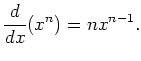
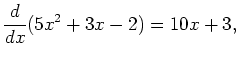
In calculus class you have learned (or will learn) simple rules
on how to find the derivative. One used often in Introductory Physics
is the `Power Rule'
 |
 |
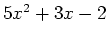 with respect to
  is
is  .
.
[BQ 10] What is the derivative
of the equation of your line from [BQ 9] at  (use the
power rule).
(use the
power rule).
[BQ 11] What is the derivative
of the equation of your line from [BQ 9] at  (use the
power rule).
(use the
power rule).