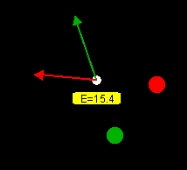
Screen shot of point
charges and a field detector.
Electric Field Detector Wrong
Model
The EJS Electric Field
Detector Wrong
model
asks
students to figure out what is wrong with the model with multiple
charges with an electric field detector. The magnitude of the field
recorded by the detector can be put into a data table and analyzed
using a
built-in
data analysis tool. Users
can examine and correct
the model if Ejs is
installed.
Exercises:
- Add
Charge to the simulation.
Move the detector charge around and observe the electric field. For one
charge in
the model, verify that the model is correct. What is your
evidence?
- Add a second identical
charge (the slider controls the charge of all the charges added to the
screen). The arrow is supposed to show the electric field due to the
charge with the matching color while the read-out is supposed to show
the electric field. Which is incorrect (the read-out or the
arrows)? What is your evidence? You may need to make some
measurements to help determine what is wrong. If so, click on the Record
button to record the values of the electric field as measured by the
detector in the Data
Table.
- Clicking on the Wrench
tool opens up DataTool,
a data analysis tool, with all of your recorded data in columns. Some
notes on using DataTool:
- DataTool
automatically draws lines between nearby points and you may find this
confusing so you can click on the checkbox with a line through it to
remove the connecting lines.
- DataTool
can provide a Fit
to the data in the first two columns. You may need to drag the columns
around in order to fit data of interest.
- If you want DataTool
to Fit
the data to an equation not in the list, you will need to edit the
current equation in Fit
Builder. For example, if
you
want to fit the data to a/x3 (and have the program
automatically find the value of a),
double-clicking on the equation of the line (a*x+b) will
automatically open the Fit
Builder. In this case, since you only want to fit one parameter,
first delete parameter "b"
(from the parameter list) and then
type your new Function = a/x^3.
- If you have EJS
installed, now that you have
determined what is wrong with the model,
correct it (be sure to check the Fixed Relations
and Custom
methods. Describe how you
fixed it. (Background required: arrays
and for
loops.)
References:
- Giancoli, Physics
for Scientists and Engineers,
4th
edition, Chapters 21 and 23
(2008).
Credits:
The Coulomb Force Wrong Model
was
created by Wolfgang Christian, Francisco Esquembre and Anne J
Cox
using the Easy Java Simulations (EJS) authoring and modeling
tool. Exercises written by Anne J Cox.
You can examine and modify a
compiled EJS model if you run the
program by double clicking on the model's jar file.
Right-click
within the running program and select "Open EJS Model" from the pop-up
menu to copy the model's XML description into EJS. You must,
of
course, have EJS installed on your computer.
Information about EJS is
available at: <http://www.um.es/fem/Ejs/>
and in the OSP ComPADRE collection <http://www.compadre.org/OSP/>.